Staff Augmentation vs Independent Contractor: Which Option Is the Best for You?

Hiring an in-house software developer typically takes 41 days from job posting to acceptance. However, when you are looking for senior or specialized roles, that timeframe can extend to up to 82 days. Such a hiring cycle can mean two to three months of project delays. By contrast, hiring a freelancer often takes around 24 hours from posting a project to the freelancer beginning work. This big difference in timeframes makes traditional hiring a less attractive model for dynamic tech projects and pushes companies to explore alternative options. For example, a lot of organizations prefer working with individual contractors. But is it the only possible solution in this case? And does it have any drawbacks for software development?
We are going to answer these questions and compare this model with staff augmentation, which is another highly popular option among companies that need to fill their skill gaps. If you are looking for the most beneficial engagement model for your project, our article will help you make an informed decision.
Staff Augmentation and Cooperation with Individual Contractors: Quick Overview
If you choose staff augmentation, talents will be provided through a vendor, and you will manage the day-to-day work of newly added specialists as part of your team.
An independent contractor is a separate business entity. This professional is hired to deliver specific outcomes or achieve milestones with high autonomy. Generally, such specialists work with minimal supervision and often bring niche expertise.
The table below covers the key differences between these approaches to hiring external professionals for your software development projects.
Aspects | Staff Augmentation | Independent Contractors |
Employment status and liability | Employed by a vendor, which also assumes HR and legal liability | Self-employed; liability remains with the contractor; businesses must handle compliance for engagement |
Typical engagement length and flexibility | Medium to long-term; cooperation is easily extendable, but less flexible for short-term changes | Short- to medium-term; highly flexible |
Pricing models and hidden costs | Vendor charges hourly or daily rates; pricing models may include management overhead | Usually a fixed, milestone-based, or hourly fee; fewer hidden costs |
Time-to-hire and ease of replacement | Faster onboarding once a vendor is in place; replacement is provided by the vendor | Fast onboarding; replacement depends on availability and may require separate sourcing |
Management overhead and owner of delivery outcomes | You will manage day-to-day tasks, and delivery outcomes will remain under your control | Contractor manages own work; you focus on deliverables and milestones; less day-to-day supervision needed |
Security posture and access control implications | Easier to enforce company policies via a vendor; centralized access control | Thorough agreements and monitoring are required; more autonomy may increase security oversight needs |
When to Use Each of the Models: Real-life Scenarios
At Anadea, we have more than 25 years of experience in delivering software development and IT staff augmentation services. Over this period, we have gained a deep understanding of the nuances of different engagement models. Thanks to this, we know when each of them can bring the highest value to businesses. Both approaches to hiring external experts have their strengths and weaknesses. Based on them, we recommend considering the following use cases.
Staff Augmentation: Scalability and Continuity
Use staff augmentation when your project requires flexibility and reliable coverage. Possible scenarios for this model include:
- multiple concurrent roles across a project;
- coverage for vacations and sick leaves;
- necessity to organize 24/7 operations;
- standardized processes that require alignment with in-house teams;
- guaranteed replacements for continuity.
This model allows you to keep day-to-day management in-house, while the vendor handles employment liability, HR, and benefits.
Looking for a reliable staff augmentation partner?
With our rich talent pool we can scale your engineering capacity without slowing down delivery.
Book a callIndependent Contractors: Specialized Expertise
Choose independent contractors when your focus is on defined deliverables and specialized outcomes. Typical use cases include:
- short-term, high-impact tasks;
- R&D experiments;
- fixed-scope projects that require specific technical expertise;
- deliverables that benefit from autonomy and minimal supervision.
Cooperation with contractors offers rapid onboarding and flexibility. Moreover, organizations can access niche skills without long-term employment commitments.
Compliance and Classification Risk That Can’t Be Ignored
Worker misclassification refers to a situation where companies wrongly categorize employees as independent contractors (often to avoid paying payroll taxes and following labor laws). Today, it is one of the most underestimated risks in engineering organizations. When you want to hire independent contractors, you should be aware of the legal standards. Regulators pay attention to behavioral control, financial control, and the level of integration between workers and your core teams.
Worker Classification Basics
Though there can be some regional differences, across major jurisdictions, classification relies on several practical factors:
- Control. Who sets hours, assigns daily tasks, establishes processes, and provides tools?
- Integration. Are hired specialists embedded in your team’s workflows and organizational structure?
- Equipment. Who provides hardware, software licenses, and access credentials?
- Exclusivity. Can these specialists take other clients? Or are they effectively full-time for you?
- Location. Are they required to work in your office or in your time zone?
- Supervision. Are they managed like employees? Or do they deliver independently to milestones?
If most of these factors indicate that you exercise employer-style control, regulators may classify the worker as an employee.
Regional Considerations
Before choosing between staff augmentation and independent contractors, it is essential to understand that worker classification rules differ significantly across jurisdictions. However, misclassification carries serious consequences (including back taxes and fines) in most jurisdictions.
- United States. The IRS common law test and the ABC test focus on independence. Apart from that, regulators verify whether the delivered work is part of the company’s core business. Penalties apply at the state and federal levels.
- United Kingdom. IR35 rules target contractors working in disguised employment, especially in those cases when they operate via personal service companies.
- European Union. Rules vary by country. The general focus is on whether the worker is economically dependent on one client and operates under direction and control.
How to Mitigate Misclassification Risks
Misclassification risk can be significantly reduced with the right operational guardrails.
- Rely on a vendor as the employer of record for staff augmentation. This shifts payroll, compliance, and employment liability to the vendor. This ensures that the worker is correctly classified as the vendor’s employee.
- Issue clear, deliverable-based Statements of Work for independent contractors. You need to define clear outcomes, timelines, acceptance criteria, and invoicing terms.
- Do not treat contractors like employees. Avoid assigning fixed schedules, internal job titles, or mandatory participation in employee-focused programs.
- Limit integration of contractors into core team rituals. Standups, performance reviews, and daily task assignments increase the appearance of control. If you require deep integration, staff augmentation will be a more appropriate option for you.
- Ensure contractors retain control over tools, work methods, workflows, and sequencing. This is a major classification signal across most jurisdictions.
- Review long-running contractor engagements every 6 or 12 months. Long duration plus day-to-day control is a high-risk combination. Periodic reviews help ensure that the structure still aligns with regulatory expectations.
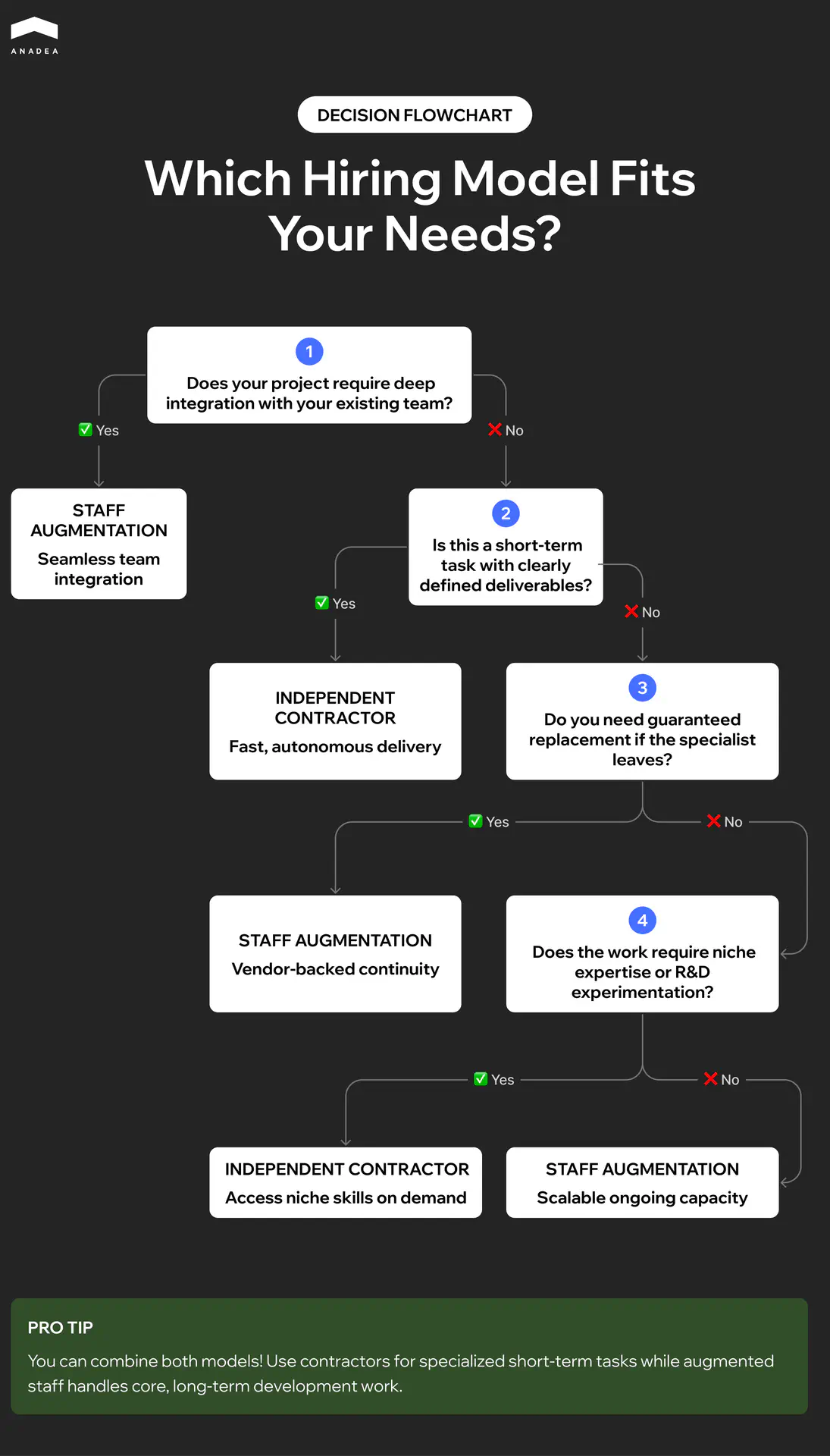
How to Find the Best Vendor or Independent Contractor?
The steps of finding the best software development specialists differ depending on whether you are going to partner with a staff augmentation vendor, like Anadea, or hire an independent contractor directly. The main goal in both cases is to validate expertise and make sure that the engagement model matches your operational needs.
Staff Augmentation: Establishing Cooperation with the Right Vendor
When you are evaluating staff augmentation partners, you should concentrate on organizational reliability and relevant project experience.
- Create a shortlist. Identify vendors with relevant domain experience and proven delivery in your tech stack.
- Review bench strength. A mature partner should have available talent ready to step in as needs expand. Bench capacity is critical for fast scaling, handling vacation or attrition coverage, and ensuring replacement resources arrive without delays.
- Evaluate replacement SLAs. Clarify response times and procedures for swapping engineers in case of turnover or performance issues.
- Ask for references. Speak with current or past clients about delivery quality and vendor responsiveness.
- Review sample profiles. Ask a vendor to share the representative engineers’ CVs. This will help you understand the typical quality of candidates.
- Define trial-period terms. Secure a risk-mitigated onboarding period (usually 2 or 4 weeks) to confirm communication and technical alignment
Want to learn more?
We recommend reading our guide on how to choose a software development partner.
Read moreIndependent Contractors: Sourcing and Validating Talent
When you want to work with freelancers or individual contractors, the search process should focus more on verifying expertise and ensuring their working approaches fit your project.
- Review portfolio and proof of work. Examine the products they’ve built, open-source contributions, case studies, and technical samples that match your domain.
- Check domain experience. Prior experience in your industry will reduce onboarding time and project risk.
- Run a trial task. A small, paid pilot task is the most reliable way to confirm quality and autonomy.
- Confirm schedule and availability. Ensure alignment on hours, communication windows, expected response times, and any other client commitments that a specialist holds.
- Establish a backup plan. Contractors have no formal obligation to provide a replacement. That’s why you should be ready for such situations in advance (for example, you should keep the contact details of a second vetted candidate to have internal coverage).
Conclusion
With the variety of business requirements and project types, there isn’t a “best” approach to scaling up your team. Both staff augmentation and independent contractors serve different operational needs. And it is crucial to understand these distinctions before making up your mind.
If you need targeted expertise and autonomy for specialized deliverables, independent contractors can offer the desired efficiency. When you are looking for scalable capacity and predictable coverage, staff augmentation is a better option for you.
For organizations seeking reliable talent, at Anadea, we can provide access to experienced professionals who can seamlessly integrate with their teams. We handle recruitment and onboarding to ensure rapid deployment and coverage across multiple roles. We offer flexible engagement models and clear reporting, which makes cooperation with us as convenient as possible. To learn more about our experience and services, do not hesitate to contact us.
Have questions?
- A situation where individual contractors become full-time employees is quite common when companies are satisfied with their work. Agreements with your future in-house employees should include provisions regarding intellectual property, confidentiality, and notice periods. It’s up to you to introduce any probationary period after the transition. However, this should also be clearly stated in the documents.
- You can hire contractors and deploy the staff augmentation model simultaneously for different project needs. Quite often, contractors provide specialized expertise for short-term tasks. Meanwhile, augmented staff is typically integrated into your internal team for longer-term projects. For smooth project management, you need to define roles and responsibilities clearly. This will help you prevent overlaps and maintain workflow efficiency.
- We recommend implementing consistent code reviews, automated testing, and version control practices, as well as maintaining regular communication through sprints or check-ins. Clear documentation, structured quality assurance, and well-established coding standards also play an important role in ensuring the desired outcomes.
- The staff augmentation model provides direct labor integrated into your team. Managed services and consulting offer an external team or firm handling a defined scope of work. Managed services focus on outcomes and accountability. IT staff augmentation ensures more direct control over individual contributors and project execution.
Don't want to miss anything?
Subscribe and get stories like these right into your inbox.
Keep reading

Top Fintech Software Development Companies
Read our article to explore the top fintech software development companies and learn how to choose the right partner for your next digital finance project.

Development Team Extension: How to Do It Right in 2026
Learn how software team extension works, what it costs, and how to choose the right partner. Practical guide with real examples from 12+ year partnerships.

IT Vendor Management Explained: How to Choose and Control Partners
What is IT vendor management and why is it important? Learn IT vendor risk management strategies, vendor selection criteria, and best practices for staff augmentation partnerships.
Contact us
Let's explore how our expertise can help you achieve your goals! Drop us a line, and we'll get back to you shortly.