What Is IT Staff Augmentation? Guide for Businesses

Internal hiring helps businesses maintain control and cultural alignment within their organization. However, the realities of the modern tech industry reveal significant gaps in this traditional approach. Rapidly evolving technologies, a global shortage of qualified specialists, and rising operational costs can make in-house hiring increasingly inefficient. Today’s IT projects require fast access to niche skills and flexible scaling. Meanwhile, the average time needed to hire a new employee, according to the “Time-to-Hire Factbook” report by AMS, is over 40 days, which is an unacceptably long period for the tech industry.
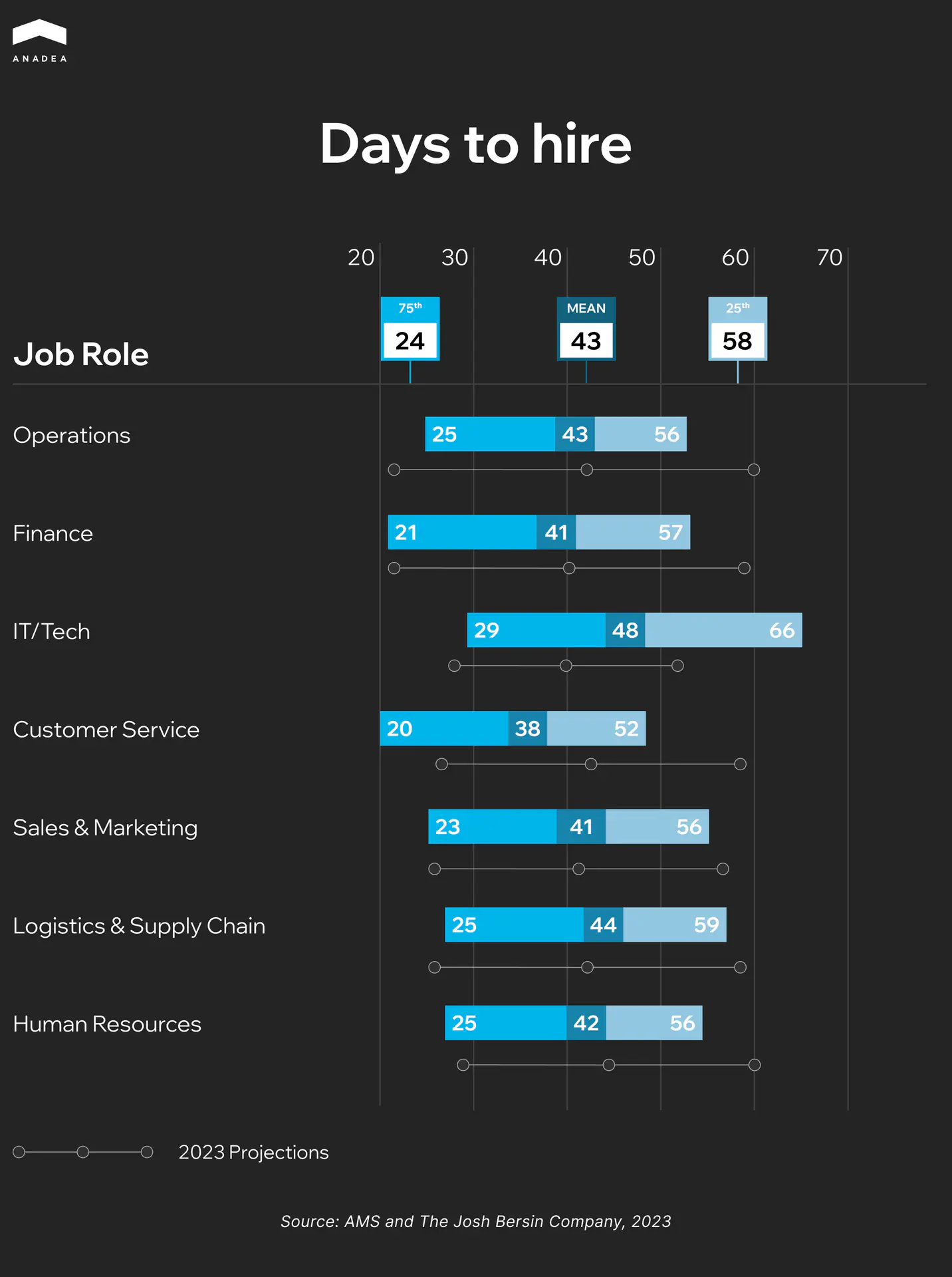
To avoid the challenges of traditional in-house hiring of software development specialists, companies from different domains turn to IT staff augmentation.
What can this model offer? And will it be suitable for your project? You can find the answers in our article. We will also compare it with other popular engagement models and share practical tips for those who will partner with an IT staff augmentation company.
What Is IT Staff Augmentation?
IT staff augmentation is a hiring model that enables companies to temporarily expand their in-house teams with external technical specialists. Instead of hiring full-time employees, organizations can bring in qualified experts on demand to fill skill gaps and support their projects.
This model gives companies direct control over the augmented team members. These external specialists work as part of the internal team. They follow the company’s processes and use all project management tools. But at the same time, they are officially employed by a vendor. It means that businesses can avoid allocating their resources to a lot of administrative and human resources tasks.
Should you develop software in-house or rely on external experts?
There are a lot of factors that you can consider before making up your mind.
Explore them now!IT staff augmentation is often confused with outsourcing, consulting, or managed services. Nevertheless, each model serves a different purpose.
- For example, while staff augmentation allows you to manage the project internally, in traditional outsourcing, an external vendor takes full responsibility for project delivery. Moreover, augmented specialists integrate directly into your team. Outsourced teams operate independently.
- When you need to outsource not just a separate project, but an entire function (like full infrastructure monitoring), the model that is required is called managed services. In this case, providers maintain responsibility for outcomes. And it is the core point in our staff augmentation vs managed services comparison. In staff augmentation, you add new specialists only to cover specific roles. Your internal team will retain control over the project.
- If we compare augmentation with consulting, we will see that consulting is typically short-term and advisory in its nature. Staff augmentation involves operational participation in the project.
The table below contains the key differences between these engagement models and will help you better understand which option is more suitable to address your needs.
Aspects for Comparison | IT Staff Augmentation | Outsourcing | Managed Services | Consulting |
Key goal | Temporary hiring of external IT specialists to support internal teams | Entire projects are handed over to external vendors | Third-party is hired to manage specific IT functions | Strategic guidance from experts |
Who manages work | Client company | Outsourcing partner | Service provider | Consultant provides advice, client executes |
Team integration | Fully integrated into the in-house team | Minimal integration | Operates separately | Low integration |
Best for | Scaling teams, filling skill gaps, project acceleration | End-to-end project delivery, cost reduction | Continuous maintenance, IT operations, support | Strategy, planning, audits, digital advisory |
According to the estimates provided by Verified Market Research, the IT staff augmentation market size is expected to reach $857.2 billion by 2031. The expansion of this market is explained by several important factors. Today, we can observe the growing need for workforce agility. Companies look for flexible staffing models to quickly adapt to changing market conditions and scale teams without long-term hiring processes. Staff augmentation helps businesses optimize their onboarding, administrative, and overhead costs associated with employing in-house specialists.
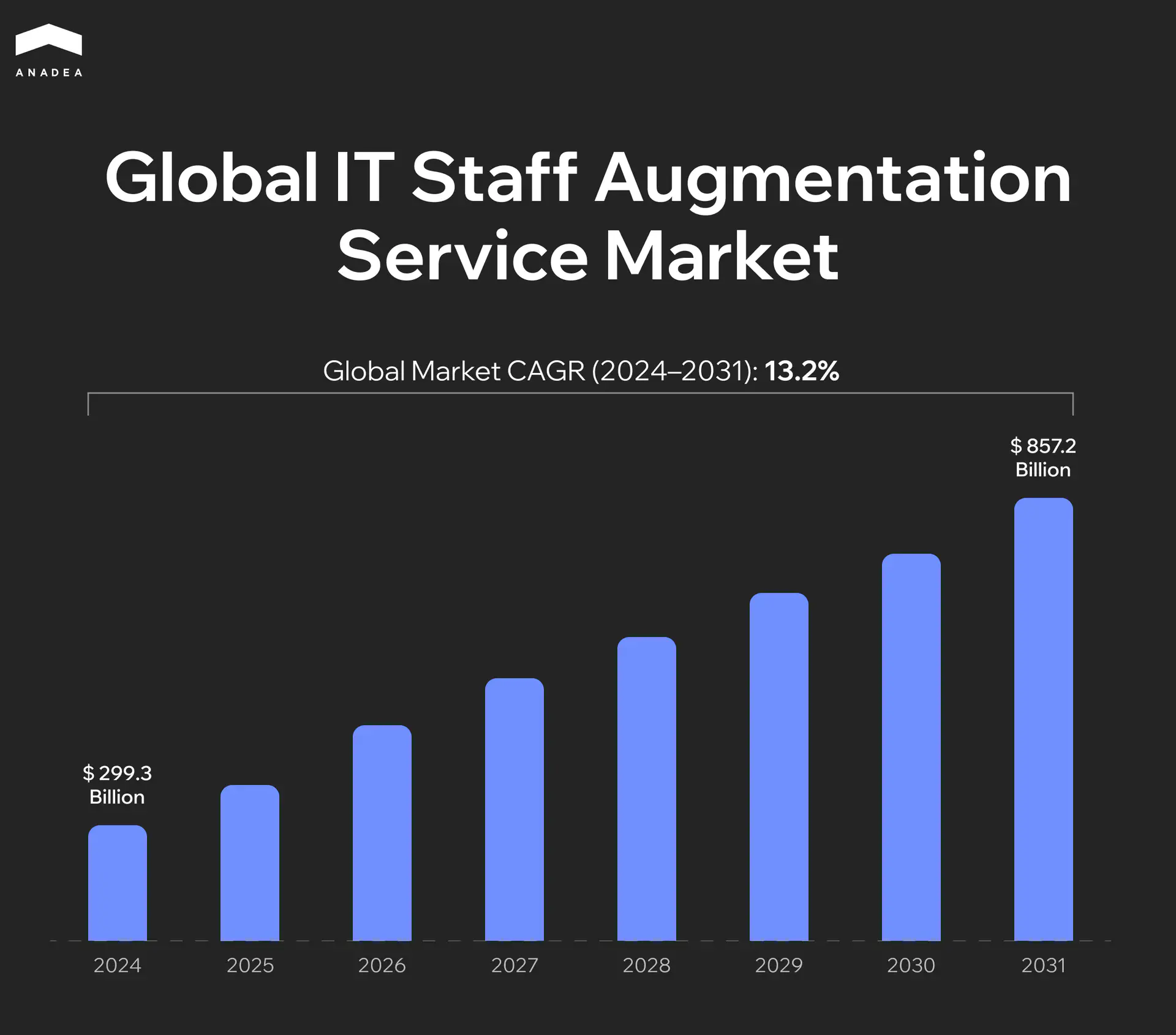
Moreover, rapid technological advancements drive demand for experts with specialized skills in strategic areas, like data science or cloud computing. This pushes organizations to rely on IT staff augmentation services to avoid delays and skill gaps.
When It Makes Sense to Partner with an IT Staff Augmentation Company
Staff augmentation provides great flexibility and can greatly accelerate the software development process. However, to fully leverage all the opportunities that this engagement model can provide, you should apply it in the right situations.
When IT Staff Augmentation Is a Good Choice
There are a range of scenarios where this engagement model is well-suited.
- Need to fill in skill gaps. When your internal team lacks some technical skills (for example, AI engineering, cybersecurity, cloud migration, DevOps, or data science), staff augmentation provides immediate access to specialists.
- Surge capacity for the most active periods. When workloads spike (major feature release, product launch, etc.), you can rapidly expand capacity with augmented team members.
- Faster hiring. Traditional recruitment processes can take months. With staff augmentation, you can get access to qualified IT professionals in a matter of days.
- Experimentation and innovation. If you decide to test new technologies or run short-term experiments, it will not be feasible to hire in-house employees. Staff augmentation provides access to experts without having to invest in expensive full-time roles to address temporary needs.
- 24/7 coverage. For companies operating in global markets, staff augmentation enables round-the-clock support. You can add team members across multiple time zones.
When It’s Better to Consider Other Options
It’s vital to realize the specifics of this model to define the situation when it can’t solve your tasks. Here are a couple of examples of such cases.
- Outcome-based projects. If a project requires fixed-cost delivery and success metrics measured by outcomes, managed services or full outsourcing may be more effective.
- Low-variance, routine operations. For repetitive tasks (routine maintenance, standard data entry, simple IT support), a managed services model provides better cost efficiency and structure.
- Lack of strong management capacity. If your internal team is already overwhelmed or lacks experienced project management, the introduction of external developers may slow progress.
Pros and Cons of IT Staff Augmentation
Like any staffing model, staff augmentation comes with advantages and potential challenges. Let’s consider them both.
Staff Augmentation Benefits
- Speed of hiring. Instead of weeks and months, you can start cooperating with new specialists just within days. This rapid time-to-hire is particularly valuable for unexpected workload spikes and urgent skill gaps.
- Flexibility. Organizations can scale teams up or down based on real-time project needs. This allows businesses to respond to market changes and evolving priorities without the long-term commitments associated with permanent employees.
- Access to global talent. Staff augmentation opens the door to an international talent pool without geographical restrictions.
- Budget efficiency. Hiring augmented staff eliminates expenses associated with full-time employment (benefits, training, paid leave, equipment, and long-term obligations). Companies pay only for the skills and time they need.
- Reduced HR and administrative overhead. As a rule, it’s a vendor who deals with recruitment, contracts, payroll, performance monitoring, and compliance.
Drawbacks of IT Staff Augmentation
- Integration and onboarding challenges. Developers will need time to understand the company’s processes, architecture, toolsets, and culture. Poor onboarding can lead to delays and reduced productivity.
- Potential security risks. External personnel will gain access to code repositories, infrastructure, sensitive data, and proprietary systems. Without proper controls, this can lead to security vulnerabilities or intellectual property risks. That’s why it is crucial to cooperate only with top IT staff augmentation companies that have already gained a reputation as reliable partners.
- Dependency on coordination and oversight. Augmented staff requires management. Coordinating across time zones and work styles can increase project management overhead. This is especially true for distributed or hybrid teams.
How to Mitigate the Downsides: Practical Tips
As Anadea has rich experience working as an IT staff augmentation company, we know the situation from the inside. It allowed us to gain a strong understanding of how to address the potential challenges of hiring external specialists.
- Establish a strong onboarding framework. Provide augmented team members with documented guidelines, architecture overviews, workflows, and access to essential tools from day one.
- Use clear collaboration practices. Set expectations regarding communication channels, coding standards, review cycles, project milestones, availability, and time-zone overlaps.
- Keep documentation updated. Detailed documentation prevents knowledge loss when augmented staff rotate out of the project.
- Use hybrid models when needed. In some cases, a combination of staff augmentation + managed services or consulting provides the optimal balance. This ensures the right balance between accountability and flexibility.
Types of IT Staff Augmentation
The staff augmentation has several types based on the geography, duration, and the team composition factor. This lets businesses with different needs and budgets choose the optimal variant.
Depending on the location of the specialists to be hired, there are onshore, nearshore, and offshore types.
- Onshore staff augmentation. In this case, you hire augmented specialists from within your own country. You can benefit from real-time collaboration and a shared business culture. However, the talent pool can be limited, while rates can be higher compared to other models.
- Nearshore staff augmentation. You cooperate with an IT staff augmentation company from neighboring or close-time-zone countries. As a result, you get near-real-time communication and lower cost than onshore. At the same time, talent availability may vary by region.
- Offshore staff augmentation. In accordance with this approach, you work with specialists from distant countries, often with significant time zone differences. Thanks to the expansion of your geography of search, you can find the most affordable option and leverage access to highly specialized global talent. Among the disadvantages, you should remember about time zone barriers, communication challenges, and potential cultural misalignment.
In some projects, it is sensible to apply a hybrid approach, which combines onshore, nearshore, and offshore resources.
From the perspective of cooperation duration, there are short-term and long-term staff augmentation types. The first option is suitable for launching MVPs or prototypes, or for projects with urgent deadlines. The long-term model means that developers joining your team for at least 6 months. In this case, they usually take part in large development cycles.
Moreover, when you are looking for resource and staff augmentation, you need to decide whether you want to hire just individual specialists to cover single roles or a team of multiple professionals. Such dedicated teams are usually hired for complex projects that presuppose continuity.
IT Staff Augmentation: Step-by-Step Process
If you are considering hiring external tech specialists to augment your in-house team, it will be useful for you to know how this process is organized.

Step 1. Formulate Your Needs
You should decide on the required skills, seniority level, technologies, and domain knowledge. Apart from this, it is necessary to define expected outcomes, duration of engagement, and budget constraints.
Based on this, you will be able to choose the right augmentation type (onshore, nearshore, offshore, or hybrid).
Well-defined requirements reduce the risk of mismatches and speed up the selection process.
Step 2. Consider Top IT Staff Augmentation Companies
You evaluate your potential augmentation partners.
Pay attention to:
- Vendor reputation
- Available case studies
- Technical expertise
- Industry experience
- Security and compliance standards
- Pricing models
When you establish cooperation with the chosen vendor, share your requirements. The team will analyze them and prepare a shortlist of specialists to join your team.
Step 3. Interview Candidates
We recommend conducting technical interviews, coding tests, soft skills evaluations, and culture-fit screening.
This step ensures the augmented talent integrates smoothly with your team’s workflow.
Step 4. Handle Legal Setup
When you choose specialists, all formalities should be finalized. As a rule, this step includes preparing and signing several documents, such as a master services agreement, NDA, IP assignment agreement, and statement of work.
Step 5. Onboard and Integrate Augmented Team Members
Proper onboarding is essential for productivity. You should provide new specialists with access to all the necessary tools and repositories. Share the required documentation, explain coding standards, and assign a team lead or internal point of contact.
Step 6. Continuously Measure the Results
It is vital to evaluate and optimize performance. However, your task is not only to track KPIs and deliverables. You also should hold regular stand-ups and retrospectives, as well as provide feedback loops between internal and augmented staff.
The estimation of progress will also help you adjust the scope and tasks if needed.
Step 7. Scale Your Team Up and Down
IT staff augmentation is known for its flexibility. You can easily add more specialists during peak workloads. And you can also easily scale your team down when project milestones are completed. Don’t ignore the necessity to ensure smooth knowledge transfer when offboarding specialists.
IT Staff Augmentation Trends
The sector of resource and staff augmentation is continuously evolving under the influence of multiple factors. The ongoing changes are driven by rapid technological innovation and the new realities of global workforce dynamics.
- Growing demand for cybersecurity talent. Cyberattacks are increasing in frequency and sophistication, which pushes organizations to scale their security operations.
- Cloud migration projects. Cloud modernization is one of the tech business trends. Organizations of all types and sizes migrate their legacy on-premises software to cloud platforms that ensure greater flexibility and cost optimization. That’s why they need temporary expertise to support such a transformation.
- AI innovation. The global race to integrate artificial intelligence into products and workflows has created a huge need for AI-skilled professionals. Traditional hiring markets can’t meet this demand. That’s why many companies rely on tech partners that can provide high-quality AI software development services.
- Global talent redistribution due to economic uncertainty. Economic slowdowns and budget cuts are driving companies toward agile workforce solutions.
- Shift toward multi-timezone delivery models. Companies now strategically distribute teams across different regions to enable 24/7 productivity cycles.
Final Word
IT staff augmentation ensures a flexible way for organizations to strengthen their teams and speed up their projects. This model can significantly reduce the time and resources that you typically allocate to the hiring process. Moreover, you can avoid a lot of administrative burdens related to employing in-house team members.
Staff augmentation can provide you with access to specialized talent exactly when you need it. Of course, it is not a universal fit for every situation. However, it is a good option for scenarios that demand speed and targeted expertise.
If your company is facing talent shortages or the need to accelerate digital initiatives, this model can become an efficient option for you. And if you are already in search of a reliable IT staff augmentation company, at Anadea, we are always ready to help you. With more than 25 years of experience in custom software development, we have accumulated solid expertise in this sphere and know how to bring real value to projects of different types. Contact us to learn more about our IT staff augmentation services.
Have questions?
- Yes, we have a large talent pool of experts skilled in a variety of technologies and tools, including highly in-demand ones like Ruby on Rails, Golang, Kotlin, and more. 100% of our developers have a degree in engineering and a rich practical experience in multiple business domains. This enables us to meet even the most specific business needs.
- For more than six years, Anadea has focused on AI development. Today, the company’s team includes numerous experts in ML, DL, and GenAI technologies. They build AI solutions across industries such as finance, healthcare, e-commerce, real estate, and many others, and can successfully support projects of various types.
- The onboarding timeline depends on the complexity of your request. Thanks to our extensive talent pool, which includes experts with diverse skill sets and backgrounds, we can quickly identify the right candidates. As a rule, onboarding can take anywhere from 48 hours to two weeks.
Don't want to miss anything?
Subscribe and get stories like these right into your inbox.
Keep reading

Top Machine Learning Software and Application Development Agencies
We ranked machine learning agencies by real case studies, technical depth, and production experience. Anadea, ScienceSoft, Tensorway, Jelvix, and 7 more companies that deliver results.

Top Fintech Software Development Companies
Read our article to explore the top fintech software development companies and learn how to choose the right partner for your next digital finance project.

Development Team Extension: How to Do It Right in 2026
Learn how software team extension works, what it costs, and how to choose the right partner. Practical guide with real examples from 12+ year partnerships.
Contact us
Let's explore how our expertise can help you achieve your goals! Drop us a line, and we'll get back to you shortly.